
Brass Forged Compression Tee for Plumbing Reliability
The brass forged compression tee is a reliable plumbing fitting. It splits or joins fluid lines, creating a leak-resistant mechanical connection without soldering. As a plumbing tee and pipe connector, it offers a secure alternative for quick serviceability and tight seals. This is essential in residential plumbing, HVAC, refrigeration, and many industrial fluid systems.
Brass—an alloy of copper and zinc—is widely appreciated for its corrosion resistance, mechanical strength, malleability, and versatility. Because of these traits, a 1/4 t fitting is ideal for carrying potable water, refrigerants, and other media where long-term durability is vital. A brass forged compression tee combines brass’s material benefits with forging’s structural advantages for a longer service life.
“Forged” indicates a manufacturing process where heated brass is compressed under high pressure in a die. This produces dense, high-strength parts with improved grain structure and fewer voids than cast fittings. In general, forged brass tee components deliver improved dimensional accuracy, greater strength, and better fatigue resistance. These attributes increase confidence in pressure-sensitive plumbing systems.
In the United States, for potable water applications, lead-free materials are critical. The Reduction of Lead in Drinking Water Act limits lead on wetted surfaces to 0.25% by weight. You should look for LF lead-free markings and certifications like NSF/ANSI 61/372 to confirm a brass compression tee is compliant for drinking water systems.
This article will cover the benefits of forged brass, product specifics for Compression Tee – Brass Forged fittings, installation and maintenance best practices, sizing and compatibility guidance, wholesale sourcing and specification resources, and a concise conclusion. Together, these sections will help you choose the correct plumbing fitting for your next project.
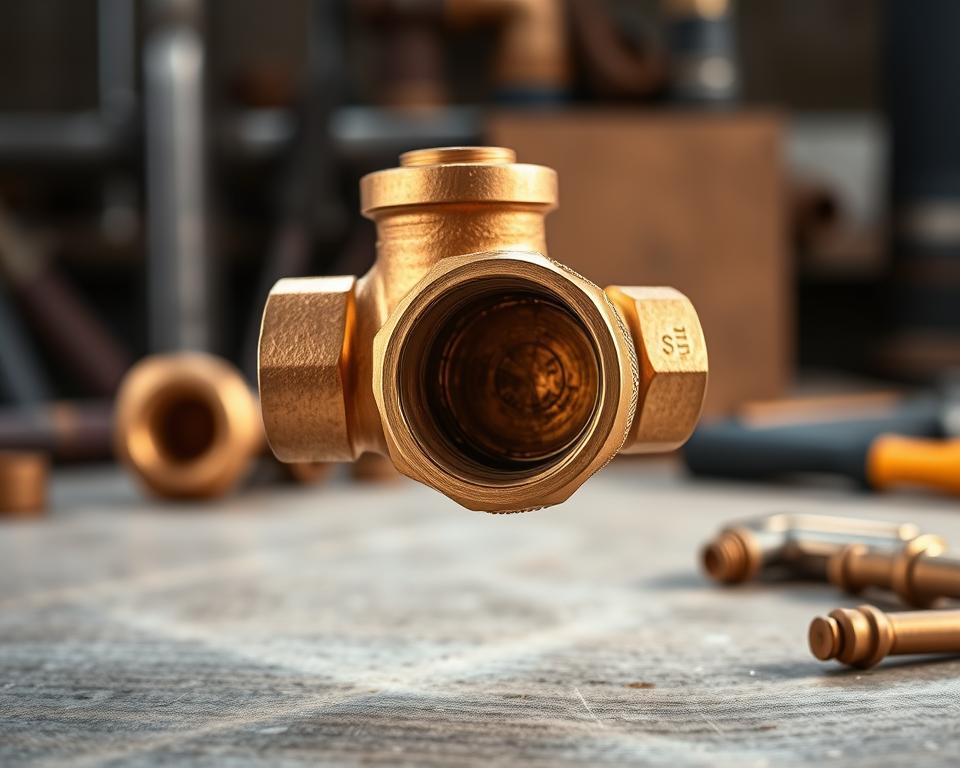
- Brass forged compression tees deliver leak-resistant connections without the need for soldering.
- Brass offers corrosion resistance and malleability, making it useful across many plumbing applications.
- Forging produces stronger, more reliable fittings than casting.
- Lead-free markings (LF) together with NSF/ANSI 61/372 certifications indicate compliance for potable water use.
- They are suitable for residential plumbing, HVAC, refrigeration, and numerous industrial systems.
Reasons To Choose Brass Forged Fittings For Plumbing Systems
Brass forged fittings bring significant advantages to plumbing projects. They combine the inherent properties of brass with advanced manufacturing techniques. That combination improves performance and helps keep plumbing systems reliable and cost-effective over time.
Corrosion Resistance And Longevity
Brass exhibits high resistance to corrosion from water and many types of fluids. This property prevents leaks and pinholes in systems handling potable water. Such resistance extends the lifespan of brass fittings, making them suitable for both residential and commercial use.
Compared to cast components, forged brass parts usually show lower porosity. The denser metal and finer grain structure reduce the risk of surface degradation and wear. This makes forged brass fittings more durable over time.
How Forging Improves Strength And Durability
Forging compresses the metal grain, increasing tensile strength and impact resistance. This enhanced structure allows brass fittings to withstand higher pressures in plumbing, HVAC, and refrigeration systems. They offer superior mechanical strength.
Compared with cast fittings, forged pieces generally have better dimensional accuracy and fewer defects. This leads to fewer failures in the field and a tighter fit during installation. This precision in forged brass tee components benefits a wide range of plumbing projects.
Lead-free compliance for potable water
Within the U.S., plumbing codes mandate lead-free brass fittings for use in drinking water systems. These fittings must meet the Reduction of Lead in Drinking Water Act standards. They are marked with LF or certified to NSF/ANSI standards.
Choosing lead-free forged brass tee components ensures safety in homes, schools, and hospitals. It maintains plumbing reliability in projects handling potable water.
Compression Tee (Brass Forged)
A forged compression tee is a compact three-way fitting that joins three tubing runs with compression nuts and ferrules. This design provides a mechanical seal without the need for soldering or flaring, making it ideal for quick, reliable connections. Common labels include 1/4 compression tee and 1/2 compression tee. You’ll also find mixed sizes like 1/2×1/2×3/8 tee for routing branches.
Overview Of Product And Common Configurations
You can get compression tees in multiple forms, such as run tees, branch tees, and union tees. In many cases, a brass compression tee is supplied as a forged male run tee. It combines compression ends with NPTF threads for hybrid systems. For smaller water lines, standard options include the 1/4 water line tee and 1/4 t fitting. Installers also search for 1/2 t and 1/2 inch t when upsizing or tying into mains.
Materials And Standards
Forged tees use brass alloys for their machinability, strength, and corrosion resistance. These alloys meet ASME and SAE criteria, common in plumbing supply chains. Each fitting consists of three parts: a compression nut, a ferrule or sleeve, and the fitting body. Depending on the tubing material, ferrules can be brass or thermoplastic.
Manufacturers publish temperature and pressure ratings according to tubing type and configuration. Standards like SAE J-512 and UL listings ensure performance in potable water, refrigeration, and fluid systems. You should always confirm the exact ratings for a brass compression tee prior to use.
Applications where forged compression tees excel
These forged compression tees are particularly effective in potable water distribution, refrigeration, and ice-maker hookups. They are also commonly used in beverage equipment, HVAC instrumentation, and low- to medium-pressure pneumatic runs. In appliance connections, the 1/4 compression tee and 1/4 water line tee are common choices. For larger branch circuits, the 1/2 compression tee and 1/2×1/2×3/8 tee are often selected.
These fittings are ideal for situations that require mechanical robustness and leak resistance without heat. They’re useful where limited disassembly is needed, though ferrules can degrade after multiple reassemblies. Opt for brass compression tee variants if you require corrosion resistance and lead-free compliance for potable systems.
| Application Feature | Example Size/Type | Typical Application | Material / Notes |
|---|---|---|---|
| Branch For Small Appliances | 1/4 Compression Tee | Ice makers and refrigerators | Uses brass ferrule or acetal sleeve with plastic tubing |
| Main Branch/Manifold | 1/2 Compression Tee | Hot and cold supply lines, distribution manifolds | Forged brass body providing added strength |
| Mixed-Size Branch | 1/2 x 1/2 x 3/8 Tee | Transition between circuit sizes | Commonly used in instrumentation and HVAC |
| Compact tee with thread | 1/4 t fitting (male-run) | Hybrid compression-to-thread connections | Ideal where mixed plumbing assemblies are used |
| Robust forged option | Compression Tee – Brass Forged | Used in applications requiring high durability | Meets functional requirements under SAE and ASME standards |
Best Practices For Installing Compression Tees
Proper installation is key to avoiding leaks and frequent service calls. When a compression fitting is assembled correctly, it ensures tight and dependable plumbing joints. Below, we’ll review the essential components, compatibility considerations, and maintenance practices for common setups.
Key Components And Assembly Steps
Typically, a compression fitting includes a nut, a sleeve or ferrule, and the fitting body. Start by placing the nut on the tubing and then installing the ferrule, with the nut threads directed outward. Push the tube fully in until it seats against the fitting shoulder.
Tighten the nut by hand and then use a wrench to complete the specified number of turns as recommended by the manufacturer. It is important to follow the recommended nut rotation counts to prevent overcompression. Using this method helps avoid damaging the fitting.
With mixed-thread connections (for example compression x NPTF), apply thread sealant or PTFE tape exclusively to the male tapered threads. Do not apply any sealant to the compression ends. Long nuts can improve vibration resistance, making them suitable for moving equipment or noisy lines.
When installing a compression t fitting, make sure the tubing ends are square and free of burrs. This helps ensure a consistent and reliable seal.
Compatibility Across Tubing Types And Sizes
Compression fittings work well with annealed copper, aluminum, and many thermoplastic tubes. Plastic tubing may require an internal insert or acetal sleeve to prevent collapse and ensure a reliable seal. Always review manufacturer guidance for compatible inserts, including those in Dixon-style product series for plastic lines.
Do not assume a pipe connector labeled with shorthand will match without checking O.D. versus port size. Cross-reference common search labels like 1/4 t fitting, 1/2 compression tee, 1/4 compression tee, 1 1 4 compression tee, and multi-size labels such as 1/2×1/2×3/8 to confirm fit. Steel tubing often needs fittings rated specifically for steel; do not use standard compression tees on steel unless the specification explicitly approves it.
Maintenance and reassembly considerations
Compression fittings may be disassembled and reused a limited number of times. Prior to reassembly, check ferrules and nuts for deformation, scoring, or worn threads. Replace ferrules and, if needed, the fitting body after repeated service to maintain a leak-free joint.
Avoid overtightening during service. Overcompressing the sleeve will deform it and compromise the seal. In systems with vibration or movement, using long-nut options, union-style connectors, or specialized dynamic fittings can help reduce maintenance frequency.
Sizing, Compatibility, And Common Search Terms Explained
A clear understanding of fitting labels saves time and helps prevent costly errors. Size markings can refer to tube O.D., NPT thread size, or a shorthand like 1/2×1/2×3/8 tee. Confirm whether a listing means tube O.D. or thread form when you see notations such as 1 1 4 compression tee or 1/2 inch t.
Compare part numbers against printed dimension tables. Manufacturers may state tolerances of +/- .02 in on key dimensions. Call the manufacturer when dimensions are critical to fit, ensuring tight clearances around a pipe tee or hydraulic fitting.
How To Interpret Size Labels And Cross-References
Look for clear labels that indicate whether the value refers to tube O.D. or thread size. A 1/4 t fitting might be shown as 1/4 in. Tube O.D. or as 1/4 NPT. Mixed-format listings can be confusing for buyers. When shopping for a 1/2 to 1/4 tee, refer to the dimension table and confirm the ferrule size.
Choosing The Right Compression Fitting For Pressure And Media
Select fittings rated for your system pressure at operating temperature. Most pressure tables reference 73°F. Forged brass components perform well in low- to medium-pressure lines. Check manufacturer notes if you are using refrigerants or gases, since some products are not recommended for gaseous media.
Verify material compatibility with your fluid. Brass is typically appropriate for water systems and numerous hydraulic fluids. When potable water compliance is necessary, make sure the listing includes NSF/ANSI lead-free certification. When your design specifies a 1/2×1/2×3/8 tee or a 1/2 inch t, confirm working pressure and certification before placing an order.
Common Compatibility Pitfalls
Mismatched tubing O.D. and port size will typically lead to leaks. In many cases, plastic tubing needs inserts or specific ferrules. Steel tubing is often excluded unless the product specifies compatibility. Avoid assuming a 1/4 t fitting works with all 1/4 tubing; check if the dimension refers to O.D. or thread.
Overtightening will deform ferrules and lead to failures. Under-tightening can cause weeps and slow leaks. Always follow the wrench-turn guidance from the manufacturer to get a secure seal. In high-vibration settings, choose designs with long nuts or vibration-rated options.
Pay attention to lead content in forged fittings. Certain forged run tees may not be lead-free. Read product notes and spec sheets before installing any pipe tee in potable water systems. When a hydraulic fitting is part of a critical circuit, contact the manufacturer to confirm pressure rating, media limits, and dimensional tolerance.
Wholesale Sources And Specification Resources
Obtaining brass forged compression tee products requires trusted distributors and detailed specification documents. Choose suppliers that are known for consistent quality, accurate alloy markings, and a wide range of appropriate sizes. A thorough product data sheet helps streamline both selection and installation.
Recommended Wholesale Distributor
For bulk orders, Installation Parts Supply is a standout choice. They offer a broad selection, from 1/4 compression tee to 1/2×1/2×3/8 tee and 1/4 water line tee. Buying in bulk from a reputable supplier reduces lead times and helps ensure consistent pricing for contractors and facilities teams.
What To Look For In Product Listings And Data Sheets
Always scrutinize the product data sheet for alloy designation, lead-free certification, and dimensional tolerances. Ensure that NSF/ANSI 61/372 markings, working pressure at 73°F, and temperature ranges from -65°F to +250°F are clearly stated.
Verify the configuration details: compression x compression, compression x NPTF, or other combinations. Check whether the part is barstock, light pattern, or full pattern; catalog suffixes may indicate “B” or “L.” Confirm whether plastic tubing requires acetal sleeves or brass inserts and whether those sleeves are included.
Look for application notes like “Not recommended for gaseous media” along with vibration guidance such as using a long nut for greater vibration resistance. These details can significantly affect the long-term performance of a brass forged compression tee.
Manufacturer Examples And Spec Resources
Manufacturers such as Dixon Brass offer detailed guidance on materials and configurations. In their documentation, you’ll find alloy numbers like Alloy 360/230 for straight fittings and Alloy 377 for forged shapes. Typical series include 60C sleeves, 61C nuts, 62C unions, and 171C male run tee.
When you are considering a wholesale purchase, ask the supplier for manufacturer product data sheets and working pressure tables. A lot of vendors provide PDF spec sheets containing part numbers, pressure ratings, temperature limits, and installation notes. It is essential to cross-check these sheets before placing large orders.
| Item | Key Specification To Check | Why It Matters |
|---|---|---|
| Brass forged compression tee | Alloy designation, lead-free certification, and pattern type | Ensures the material is suitable for potable water and provides the needed strength |
| Wholesale Brass Tee Listings | Available sizes, packaging quantity, price breaks | Helps keep procurement within budget and meets project quantity requirements |
| Wholesale orders for compression tees | Working pressure at 73°F, temperature limits, and dimensional tolerances | Prevents selection errors that could cause leaks or failures |
| Plumbing Fitting Distributor Support | Inventory levels, technical documentation, and channels for custom requests | Simplifies replacement, traceability, and special-order requirements |
| Manufacturer spec resources (example) | Part series, application notes, contact info | Provides authoritative installation and maintenance guidance |
Before making a purchase, contact the supplier or manufacturer for any needed clarification. Request current product data sheet PDFs and confirm availability of the exact brass forged compression tee model needed. These steps minimize risks and ensure installations are completed on time.
Summary
The brass forged compression tee represents a robust, leak-proof, and code-compliant solution for tubing connections in a range of systems. It ensures reliable service and enhances plumbing longevity when properly chosen. The right material, size, and configuration are key to its success.
Choose forged brass if you want superior strength and durability. It resists deformation and maintains thread integrity better than many cast alternatives. For safe potable installations, verify lead-free certification and follow the manufacturer’s installation instructions. Avoid common mistakes such as size mismatches, overtightening, or using incompatible tubing.
For wholesale purchases, consider reputable distributors such as Installation Parts Supply. Review manufacturer datasheets, including Dixon Brass specifications, for detailed information on alloys, pressure ratings, and dimensional tolerances. Proper selection and maintenance of a pipe connector are essential for achieving optimal performance and cost savings.